
Fund managers with exposure to data centre assets face a quietbut consequential shift: from 2027, a standardised EU rating label – as proposed by draft regulation Ares(2026)3247482 – will make sustainability performance across the sector publicly comparable for the first time. For portfolios that are built before this anchor is introduced, the question will no longer be whether such labels are useful, but rather how current holdings will score once it applies, what that means for valuation and how to adapt investment strategies in order to position ahead of a forced retrofit.
Data centres are the physical backbone of the digital economy – and, like most industrial infrastructure, their energy footprint is rising with demand. According to the Directorate-General for Energy of the European Commission, by 2030, the sector alone is projected to account for 3.21% of EU electricity consumption, up 28% from 2018. Whether one interprets the consumption intensity or the growth trajectory as a case for or against the asset class is beside the point; what matters for capital allocation is that data centre sustainability now has a regulatory anchor to be measured against.
Regulatory Framework
Understanding the architecture behind the EU’s most recent move is a prerequisite for credible fund design – not optional preparation. Three interlocking pillars will anchor the assessment of this asset class in the future:
1. The Energy Efficiency Directive (EU) 2023/1791, which requires all data centre owners and operators with an IT power demand exceeding 500 kW to report annually on KPIs to the European database, first due in 2024
2. Delegated Regulation (EU) 2024/1364,in force since June 2024, operationalises existing requirements via requiring datacentres to report predefined raw data. The EU database then refers to this raw data in order to calculate and disclose the four indicators Power Usage Effectiveness (PUE), Water Usage Effectiveness (WUE), as well as an Energy Reuse Factor (ERF) and a Renewable Energy Factor (REF); and
3. The draft regulation for an EU rating scheme (Ares(2026)3247482), published on March 26th2026, is expected to be adopted later this year and shall act as converting data into a public label that is first being issued by 15 August 2027 and annually thereafter — combining PUE, WUE, REF and an additional fourth indicator, Cooling Degree Days (CDD), as well as voluntary features as follows:

Together, these three layers will evolve from a reporting obligation to a sustainability comparabilitystandard – a standard that is precisely what has been missing so far.
From Patchwork to Anchor
Managers running SFDRdisclosing funds with digital infrastructure exposure are aware of the gap: EU-level guidance on sustainability indicators for data centres has been scarce. The result was a patchwork of proxy frameworks – the EU Code of Conduct, the Climate Neutral Data Centre Pact (CNDCP) or even national building standards. While each is useful for assessing data centre assets on their own, none has emerged as comparable across the market. However, from 2027, the EU label is to evolve into the primary, public reference point. The question for asset management is therefore rather how to integrate it and not whether to.
Efficiency in Context: Where do we stand?
Size and location both shape where an asset is likely to land on the rating scale; disentangling the two is essential before drawing conclusions about a portfolio holding. With regard to Power Usage Effectiveness, results from Uptime Institute’s Global Data Center Survey2025 compared to disclosure on 2025’s efficiency metrics by major hyperscalers show the following gap:
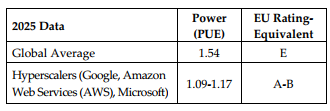
This gap reflects not only scaledriven design advantages at capacityintensive facilities, but also vintage effects: as Uptime Institute’s research shows, larger facilities tend to be newer builds that disproportionately benefit from leadingedge, efficiencyoptimized designs.
In addition, location adds a second, independent layer that is relevant for assessing data centre investments: national regulation andclimate conditions shift the baseline regardless of size. Since July 2026, Germany’s “Energieeffizienzgesetz” (EnEfG) of 2023 mandates a maximum PUE of 1.2 for new builds (Bequivalent under the EU rating proposal); the Netherlands have already restricted new capacity around Amsterdam based on grid congestion and spatial planning limitations; and the Nordics benefit from free cooling and renewable energy availability, positioning new builds “naturally” for AB ratings in terms of power and water efficiency.
Fund Design Implications
With the rating architecture and efficiency drivers in view, the practical question for fund managers shifts from understanding the label to acting on it. In practice, this means deriving investment strategy design implications from the rating regime ahead of 2027; such as:
-
- Universe definition: target AB rated assets, or pursue transition strategies for CE rated assets with credible capital expenditure (CapEx) pathways;
-
- Risk screening: exclude Grated assets and scrutinize data centres in the EF range without upgrade pathways ahead of the introduction of minimum performance standards at EU level; and
-
- Enhance renewable procurement: the draft scheme tightens guarantees of origin (GO) accounting to require time and locationmatching – a compliance challenge for owners and operators, but also a differentiation opportunity for investment strategies.
Conclusion
The way of going forward seems clear: Digital infrastructure across Europe shall become more environmentally friendly. In that regard, the EU label is not merely acting as a compliance exercise – it is rather to influence asset allocation in terms of eligibility, valuation and financing. Fund managers who integrate the proposed anchor into asset selection criteria, engagement or disclosure early will be better positioned than those who must later react. In the end, it is structural demand, clear regulatory direction and firstmover opportunities that are precisely the foundation on which institutionalgrade sustainable infrastructure funds may be built upon.
Fenja OLKPUDER, Head of ESG Advisory & Tax Services
Philipp ENDRES, Senior Specialist ESG Advisory Real and Financial Assets
The article was originally published in AGEFI.